
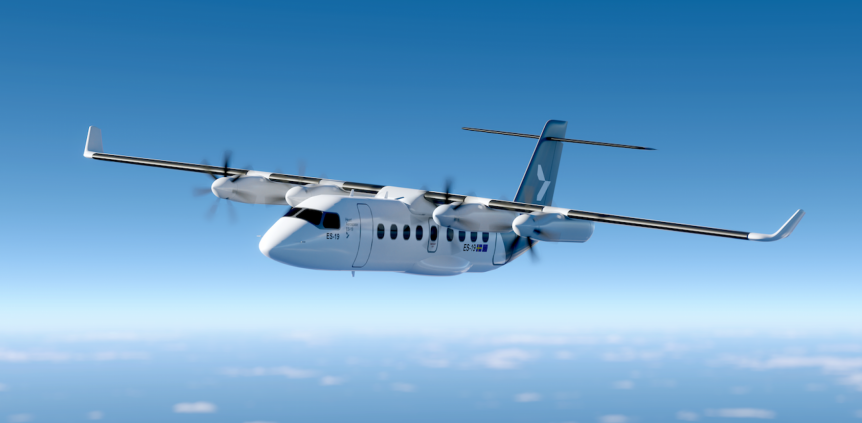
Finnair has entered into an agreement with Heart Aerospace, an electric aircraft developer from Sweden, which could result in the purchase of up to 20 of the 19-seater ES-19 aircraft, which it intends on using on short routes. Anders Forslund, CEO of Heart Aerospace has confirmed more than 300 potential orders from 12 airlines that have signed letters of interest, with Finnair being the most notable.
In September 2020, Heart Aerospace disclosed the electric propulsion system that is required to power the ES-19 airliner, that it believes will be ready to enter the market in 2026. The ES-19 features four propellers that are powered by electric motors. The primary design for the aluminum-fuselage, fixed-wing model exhibits winglets and a tail that is T-shaped. This is a bit similar to a small-scale form of the De Havilland Canada Dash 7.
As stated by Forslund, Heart is expected to publicize several partners who will provide major systems for ES-19 and possibly contribute to the manufacturing as well. Furthermore, Finnair’s purchase would enable Heart to achieve its goal of flying carbon neutral by 2045, as it has an objective of reducing carbon dioxide by 50% from its fleet by 2030.
In 2019, Finnair joined the NEA, Nordic Network for Electric Aviation, which has provided a platform for corporations and airlines to establish sustainable means of traveling. The Norwegian government has also given out instructions for all domestic flights to use electric aircraft by 2040. In Sweden, all domestic airlines have been given the mandate to run without fossil fuel by 2030, which will affect international flights by 2045. The Swedish government also intends to introduce charges on takeoff and landing from July which it presumes will encourage the use of more fuel-efficient aircraft with minimal carbon emissions.
According to Heart, the all-electric aircraft is estimated to fly up to 400 km (217nm), at a speed of 215 knots and operate on runways with distances as short as 750 meters (2461 feet), as well as cruise at speeds of 180 knots. The corporation maintains that these low speeds will not be a drawback to short sectors as the ES-19 will be able to operate from small-scale airfields which are less crowded thus minimizing door-to-door travel times.
In a bid to address infrastructure requirements, Finnair would have to develop smaller airports to enable flights between smaller towns and cities. Anne Larilahti, Finnair head of sustainability explained, “You need to recognize what is required at the airports as well, as you cannot expand faster than the obtainable resources that hold up these airplanes.”
Charging points will be necessary at every airfield where the electric aircraft lands and takes off. While Heart maintains that the ES-19 batteries could be fully charged by ground crews 1000 times over their lifetime, the aircraft would require charging each time they land.
Larilahti ultimately mentioned how the cold weather in the Nordic region makes it the ideal place to launch electric aviation technology. “Our cold weather affects operating a light airplane and batteries. If we can do it here, it will be easier to do it elsewhere.”
About FlexAir Charters
Flex Air Charters believes that convenience, comfort, safety, and efficiency should not be compromised. This is why we offer a variety of charter services to fit any traveler, any destination, time frame, and any budget.
Our services are private charters including corporate air charters, jet cards, group charter flights, air cargo charters, specialized charters, and aircraft sales.
Photo Credit: Heart Aerospace